Most base enquiries start with the wrong question — “what is your heaviest base?”. Weight is only one of four things that decide whether a flag stands, and on soft ground it is the least important of the four.
This guide works in the order the decision actually happens: ground first, then rotation, then footprint, then weight. Get that order right and the base choice becomes obvious.
The five questions that specify a base
Answer these five and the family chooses itself:
- What is the ground? Grass, soil, sand, paving, indoor floor, wall, or a vehicle.
- How big is the flag, and how tall is the pole? The flag is the load; the pole is the lever.
- Does the flag need to swing? Almost always yes outdoors, almost never indoors.
- Do you have to carry it? A base that travels empty is a different product from one that does not.
- What is the worst week of the year, not the average week? Exposure decides more than size.
Step 1 — choose by ground surface
This single column eliminates most of the range.
| Ground | The family that works | Why |
|---|---|---|
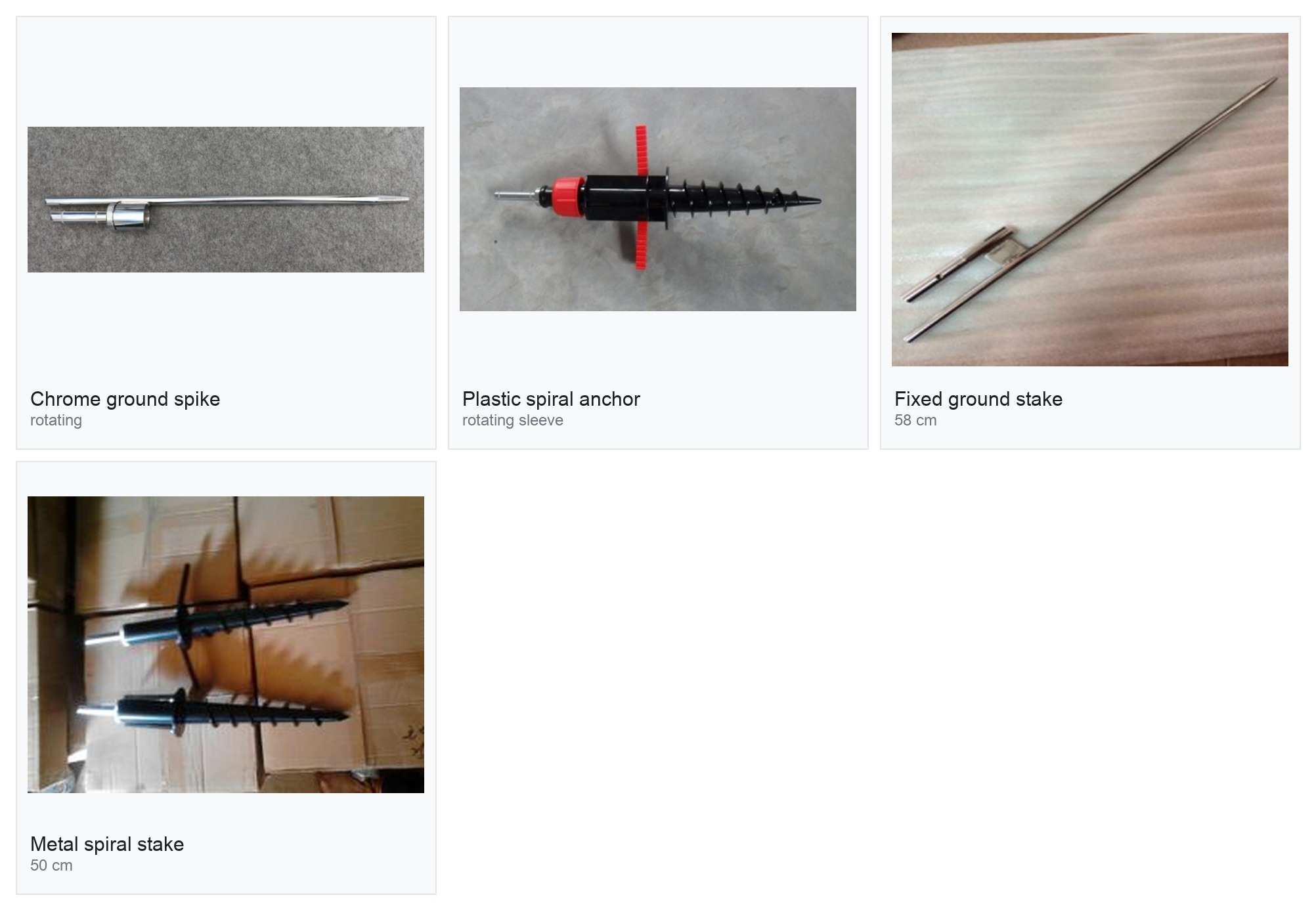
| Grass, soil, verges | Ground spikes and spiral anchors | Weight sinks; a stake grips below the surface |
| Sand, beach, loose ground | Spiral anchor, not a straight stake | A straight shaft pulls out; a spiral resists it |
| Paved, hardstanding, astroturf | Cross bases or steel plates | Spikes will not enter; plates and legs sit flat |
| Indoor, polished floor | Cross base with rubber feet, or a water base | A bare steel plate scratches the floor |
| No steel allowed on site | Water-fill base or water bag | Ballast arrives and leaves as water |
| Wall or column | Wall mount base, 45° or 90° | The wall becomes the foundation |
| Vehicle or forecourt | Car base | Built to fold, and to be moved with the car |
Step 2 — rotation, the decision people skip
A flag that cannot swing takes the wind flat-on, and a flat-on flag levers its pole sideways. That is what a leaning flag looks like at the end of the day, and what a loosened ground spike looks like by the end of the week.
- Rotating — the pole turns so the flag faces the wind. This is the default for outdoor advertising flags, and most of our cross bases, the chrome ground spike and one water-fill variant are supplied with a rotator.
- Fixed — the pole holds one orientation. Correct indoors, on a wall bracket, and on a vehicle where the flag must sit at a set angle.
A fixed base is not a dead end: the rotator is available as a separate part, so a base can be upgraded in the field instead of replaced.
Step 3 — footprint before weight
Stability is a lever problem, not a mass problem. A base holds a pole up because its legs or plate reach past the point where the flag’s load pushes down. A small heavy plate and a large lighter plate can weigh the same and behave completely differently.
Which is why our steel plates step up in diameter and weight together — 30 cm at 4 kg, 35 cm at 6 kg, 37 cm at 8 kg, 48 cm at 12 kg — and why the aluminium cross base, at only 0.7 kg, stands a feather flag on an 80 cm span.
Rule of thumb: when you are torn between two grades, take the one with the larger footprint.
Step 4 — weight, and when to refuse to carry it
Weight only helps if the ground can take it, and it costs money in every direction you move it. Two ways out:
- Water ballast. Our water-fill bases hold 20 kg, and the bags hold 7 kg or 10 kg — and ship empty. The 10 kg bag weighs 180 g empty and 100 of them fit a single carton. For air freight and for promotional fleets handed out at events, this is the difference between viable and not.
- Volume over mass. For sea freight, steel plates are dense and compact; water bases are bulky and light. Price the container before you choose.
Step 5 — match the base to the pole
Almost every base in our range carries the same sleeve: standard 14.5–16.7 mm, with other diameters made to order. That means you can standardise on one pole diameter and draw from six families without re-tooling — and if you already own poles, we sleeve the base to match rather than asking you to buy new ones.
Send the pole diameter, not just the flag size. A base is built to the pole it will hold.
The five mistakes that cause most failures
- Buying the heaviest base instead of the right one. Weight on soft ground sinks.
- Specifying a fixed base outdoors. The flag takes the wind flat-on and the pole leans.
- Choosing weight over footprint. A small heavy plate tips; a wider lighter one does not.
- Ignoring how it travels. A base that cannot be carried will not be used.
- Sizing the flag without sizing the base. The flag is the load; the base is not limitless. For how wind load drives that calculation, see how to choose a flag base for wind load.
The range, by family
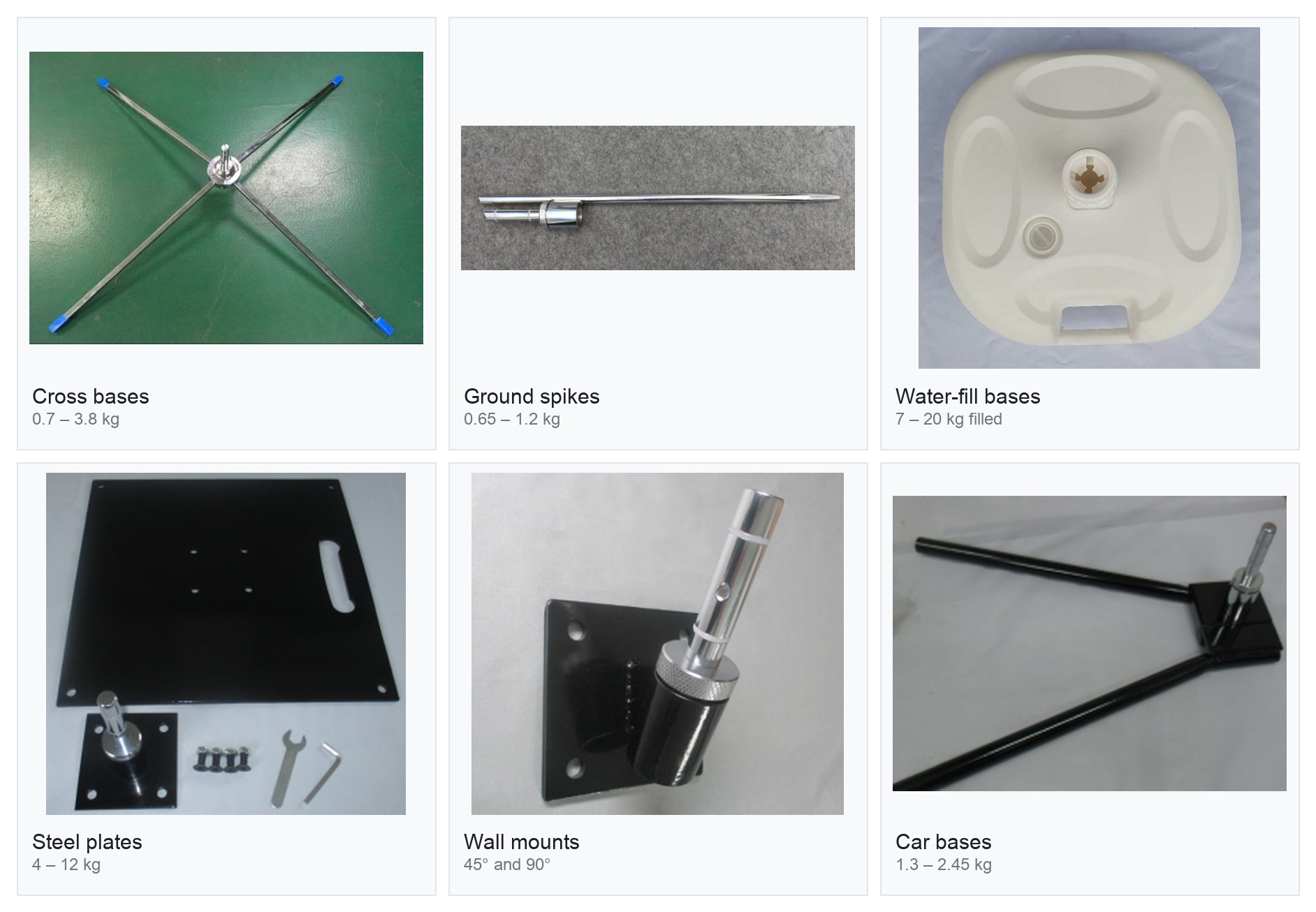
- Cross bases — six models, 0.7–3.8 kg, rotating or fixed
- Ground spikes and anchors — four models for soft ground
- Water-fill bases and water bags — 7–20 kg, ship empty
- Steel plate bases — 4–12 kg, with rotator or fixed post
- Wall mount bases — 45° and 90° bolt-on brackets
- Car bases — folding, rotating sleeve and with-pole versions
All six families are listed with weights, deployed sizes and packing on the flag bases overview page.
Get a quotation
Send the ground surface, the pole diameter and the flag size, and we will recommend the family and confirm the specification. There is no minimum order — one piece is a valid order — and bases can ship together with poles, banners and accessories as one consignment. Custom colours, finishes and pole diameters sit under our OEM / ODM service.