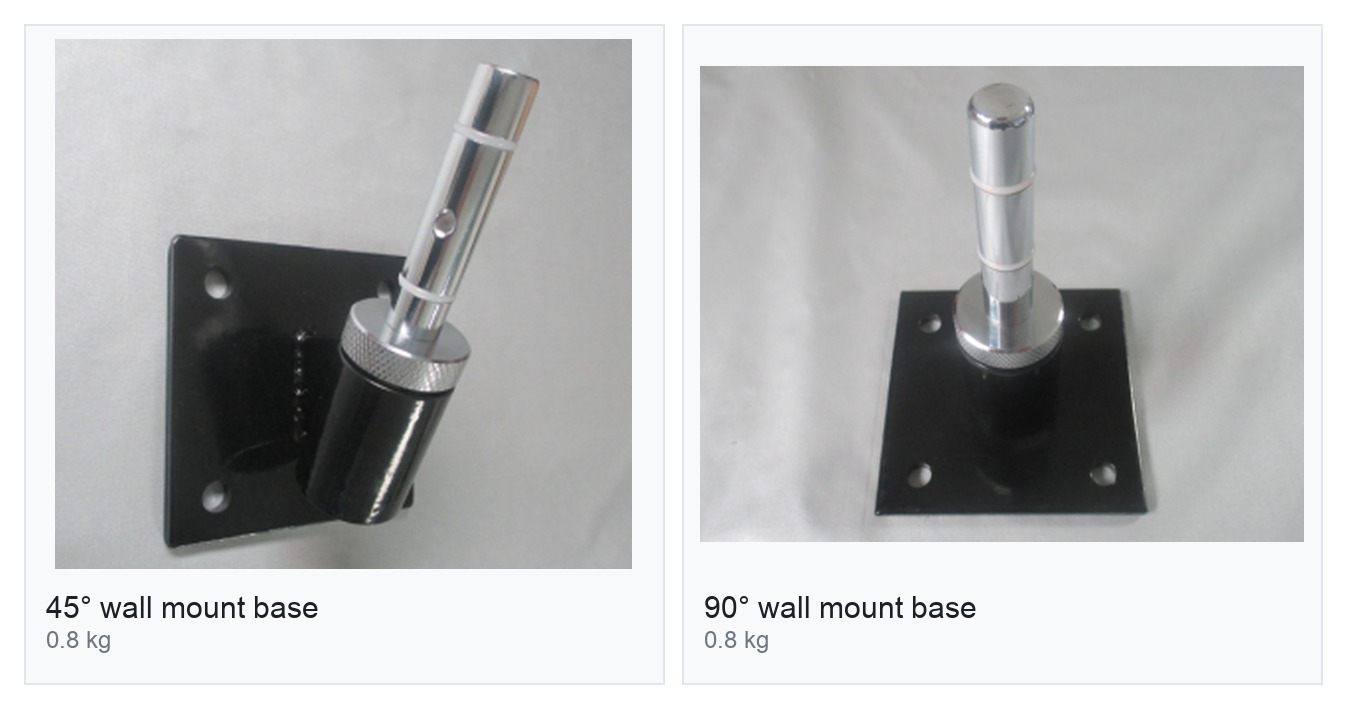
When there is no floor to stand a base on, the wall becomes the foundation. These are two compact bolt-on brackets — one holding the pole vertically, one holding it at 45° — for shopfronts, columns, interior walls and any facade where a flag has to sit flush.
The two models
| Model | Angle | Weight | Material / finish |
|---|---|---|---|
| Wall mount base | 45° | 0.8 kg | Iron, electrostatic powder coating + chrome plating |
| Wall mount base | 90° | 0.8 kg | Iron, electrostatic powder coating + chrome plating |
Both take the same pole sleeve: standard 14.5–16.7 mm, other diameters made to order.
Which angle
- 90° holds the pole vertical against the wall — the flag hangs out from the bracket. Use it where the pole has to run straight up, such as a narrow shopfront or an interior column.
- 45° throws the pole out and up away from the wall, so the flag clears the facade and sits above head height. Use it where the wall is deep, where there is an awning or signage below, or where a vertical pole would foul a window.
The 45° version is also the one that keeps a flag clear of pedestrians where the wall meets a pavement.
What the bracket does not do
A wall bracket transfers load into the wall — it does not absorb it. Two things must be checked before ordering:
- The fixing. The bracket is only as strong as the wall behind it; masonry, brick and lightweight panels need different anchors.
- The lever. A wall-mounted pole is a lever arm working on its fixing. A longer pole or a bigger flag multiplies the pull-out force on the anchor — so upsize the fixing, or drop to a smaller flag, rather than assuming the bracket is the limit.
Where they are used
- Shopfronts and retail facades
- Hotel and office entrances
- Interior columns and reception walls
- Stands, exhibition booths and display walls where a floor base would be a trip hazard
Ordering
No minimum order. The 0.8 kg bracket packs small, so it is cheap to add to a flag or pole order. Supplied with the powder-coated and chrome-plated finish as standard.
Get a quotation
Tell us the pole diameter, the flag size and the wall construction, and we will confirm the angle and the fixing advice.