Two numbers decide what a flag looks like in place: its size and its ratio. Buyers almost always specify the first and forget the second — which is how a flag arrives the right size and still looks wrong on the pole.
Ratio: the number nobody specifies
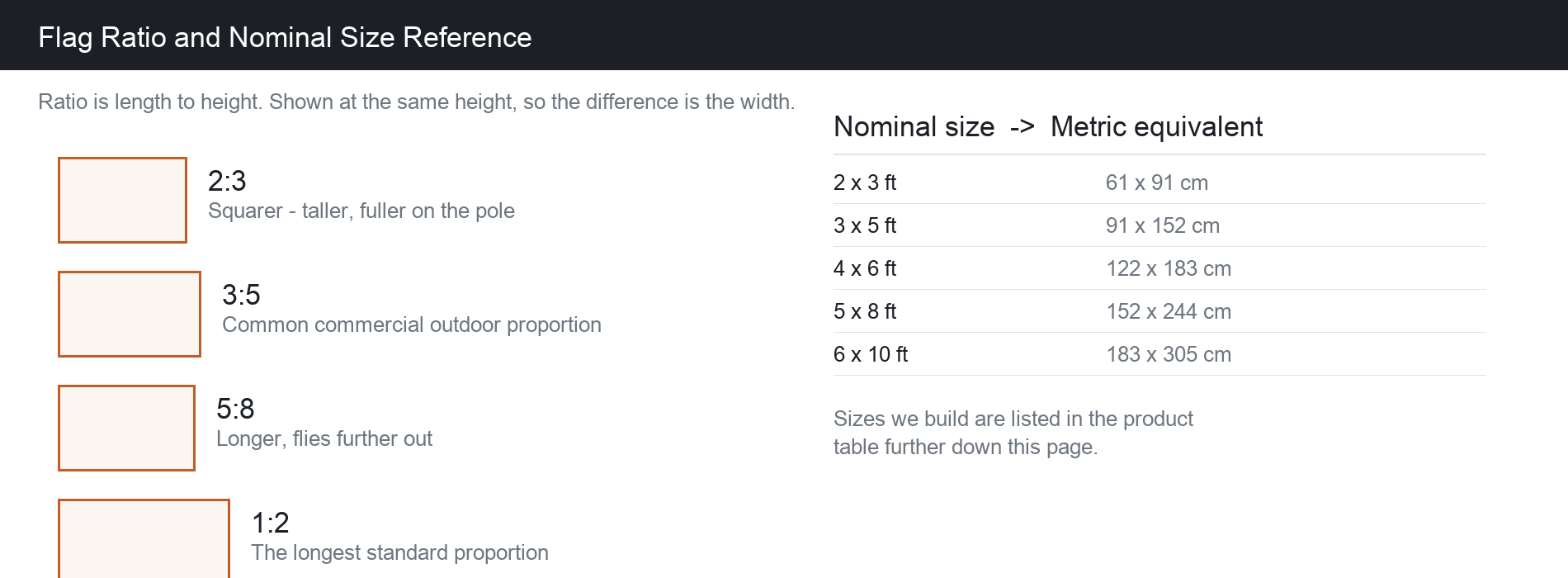
Ratio is length-to-height. It is not a style choice — it comes out of the design:
- A flag built to a squarer ratio looks taller and fuller on the pole.
- A flag built to a longer ratio looks narrower and flies further out from the pole.
- The same nominal size in two different ratios uses different amounts of fabric and puts different load on the pole.
This matters most when a flag is being reproduced. If you are making a national flag, the official ratio is part of the design and must not be adjusted to fit a convenient size — a national flag made to the wrong ratio is a compliance problem, not a design preference. Send the design file and the ratio comes with it.
For corporate and promotional flags there is no fixed ratio, and this is where the choice is genuinely free. Decide it against the pole and the viewing distance, not against a supplier’s stock list.
Nominal sizes and their metric equivalents
Outdoor flags are normally ordered by nominal imperial size. The conversions below are what those names actually measure:
| Nominal size | Metric equivalent | Typical use |
|---|---|---|
| 2 × 3 ft | 61 × 91 cm | Hand-held, small indoor display, boat staffs |
| 3 × 5 ft | 91 × 152 cm | The most common house-pole size |
| 4 × 6 ft | 122 × 183 cm | Larger house poles, low commercial poles |
| 5 × 8 ft | 152 × 244 cm | Commercial poles |
| 6 × 10 ft | 183 × 305 cm | Large commercial poles, high-wind exposure sites |
Hand and desk flags are quoted in millimetres or centimetres instead, because the nominal trade sizes do not apply at that scale. Our confirmed sizes are listed further down.
Which size for which job
| Application | Size driver |
|---|---|
| Hand-held and event giveaway | Reach and weight — a flag that gets waved cannot be heavy |
| Desk and conference table | Table footprint and how many flags sit in one row |
| House pole | Pole height and the pole’s rated load |
| Commercial pole | Pole height, windspeed exposure, and the halyard and truck rating |
| Feather and banner flags | Banner height, which is set by the flag’s own format rather than by a ratio |
| Vehicle and window | The mounting surface — the flag cannot be larger than the mount can carry |
Size and the pole: where most orders go wrong
A flag is a sail. The load it puts on a pole, a bracket or a fitting scales with the flag’s area, so the relationship is not linear:
> Doubling a flag’s linear size roughly quadruples its sail area — and the load it puts on the pole and fittings.
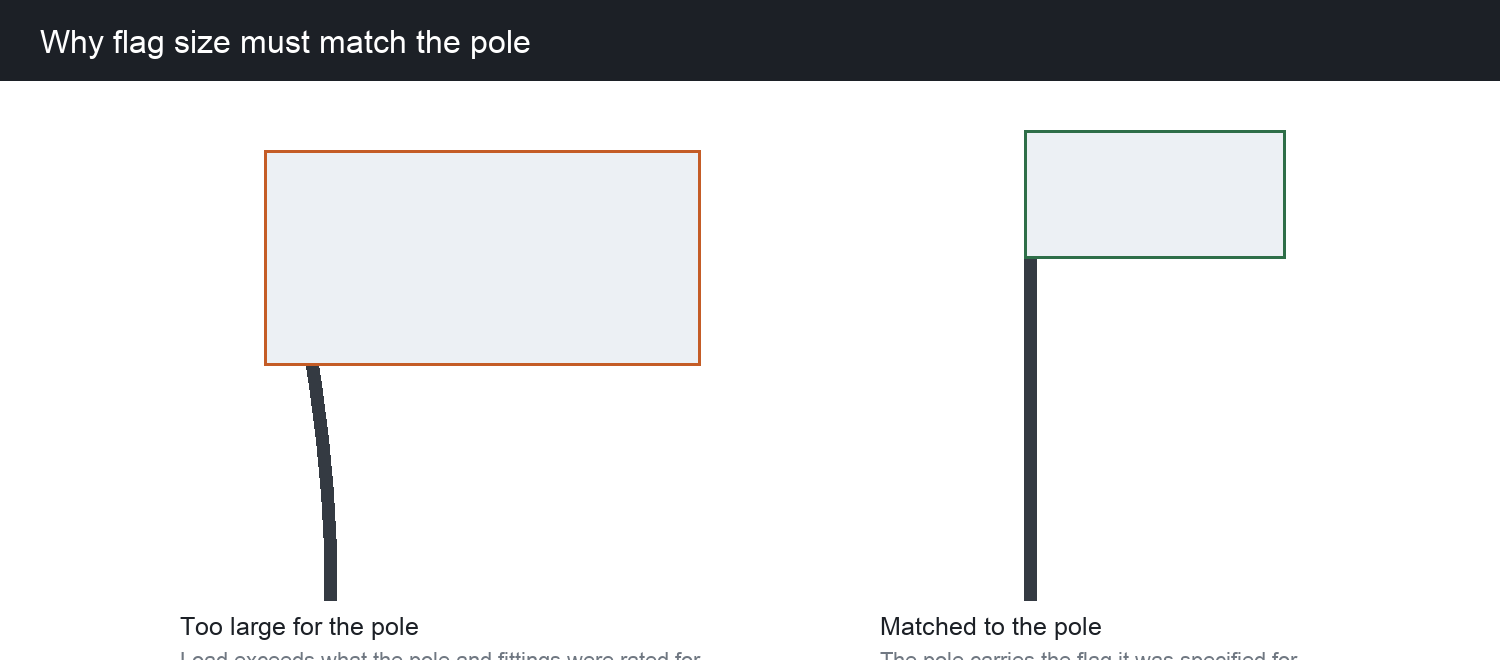
That is why an oversized flag on a light staff is the single most common cause of hardware damage, and why the flag’s hoist should be kept in proportion to the staff or halyard it hangs from.
Two practical consequences:
- Never upsize the flag without upsizing the pole or mount. The pole has a rated capacity, and the flag is the load.
- Wind exposure decides more than size does. A 3 × 5 ft flag on an exposed site can load its pole harder than a 5 × 8 ft flag in a sheltered courtyard.
The sizes we build
These are the sizes confirmed against our own product range:
| Product | Size |
|---|---|
| Hand and stick flags | 150 × 100 mm, 210 × 140 mm, 200 × 300 mm |
| Table and desktop flags | 14 × 21 cm (custom sizes available) |
| Car window flag | 30 × 45 cm |
| Magnetic car flag | 14 × 21 cm |
| Feather flag format (complete set) | 0.7 × 3.8 m banner on a 4.3 m pole |
Choosing between two sizes
When a buyer is torn between two sizes on the same pole, three questions settle it:
- How far away will people see it? A flag reads at roughly its own height in distance terms; if viewers are 20 m away, a small flag is not a small version of a big one, it is an unreadable one.
- What is the pole rated for? The pole’s capacity sets the maximum, not the customer’s preference.
- What happens in the worst week of the year, not the average week? Wind is what breaks flags and poles; size is what decides how much of it the pole takes.
Where to go next
This page is the reference; these go deeper on the specific decision in front of you:
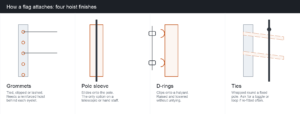
- How the flag attaches — grommets, pole sleeves, D-rings or ties
- Flagpole accessories — halyards, finials, clips and mounting hardware
- Bases — in-ground versus surface mount, and how to read a wind rating
- Feather, teardrop or knife flag — how the banner format changes everything
- Commercial flagpole installation — what gets specified and who signs off
- Flagpole installation, 20 ft telescoping — the three things that cause almost every failure
- Boat flags — fabric, size and rigging for marine use
- Flag poles for a house — what to check before buying
- Car flags and window flags — mounts, sizes and bulk orders
- Custom inflatables — when the display is a structure rather than a flag
- Custom and standard flags — sizes, fabrics and printing options
- Browse the ranges — flag banners, outdoor flag poles, indoor flag poles, flagpole accessories
Get a quotation
Send the intended use, the pole (or the mount) and the design file, and we will confirm the size, the ratio and the attachment as one specification. Custom sizes and custom ratios sit under our OEM / ODM service.