Look at a wall of national flags and the first impression is variety. Look for a minute longer and the variety turns into a small number of repeated ideas. Almost every national flag in the world is built from the same short list of devices — bands, crosses, stars, crescents, discs and emblems — and the reason that matters commercially is simple: a buyer ordering flags for many countries is not ordering two hundred unrelated designs. They are ordering a handful of design families, repeated with different colours.
That is what makes a multi-country order manageable, and it is what this guide is about.
The five design families

1. Bands, horizontal. A field divided into horizontal stripes is the single most common construction in the world. Three equal bands — a tricolour — appears across Europe, Asia and Africa: Germany’s black-red-gold, the Netherlands’ red-white-blue, Russia’s white-blue-red, and Thailand’s five-band arrangement of red, white and blue all belong to this family. So do the pan-African flags built on red, black and green.
2. Bands, vertical. The same idea rotated. France’s blue-white-red, Italy’s green-white-red, Ireland’s green-white-orange, Belgium’s black-yellow-red and Romania’s blue-yellow-red are all vertical tricolours. From a production point of view these are the easiest flags to print consistently, because a small registration error shows less on a straight band than on a diagonal.
3. Crosses. A cross laid over the field defines the Nordic group — Denmark, Sweden, Norway, Finland and Iceland — where the cross is offset towards the hoist rather than centred. Switzerland is in the same family but square, with a white cross on red. The distinction between an off-centre and a centred cross is one of the details that separates a correct flag from a generic one.
4. The crescent and star. Turkey, Tunisia, Algeria, Pakistan, Malaysia and Azerbaijan all use a crescent, usually with a star. Saudi Arabia belongs to a different group — a green field carrying the shahada and a sword — but it is equally common in ceremonial and government orders, which is why our own catalogue includes a dedicated Saudi flag alongside the general country range.
5. Emblems, charges and cantons. This is where flags get complicated, and where printing quality shows. The United States flag combines stripes with a canton of stars. The United Kingdom’s union combines three crosses. Australia and New Zealand place the union in a canton with their own stars. Japan is a single red disc; South Korea a taegeuk with four trigrams; Canada a maple leaf; Brazil a green field, a yellow rhombus and a blue globe; India a tricolour with a wheel. And Nepal — the one national flag in the world that is not a rectangle — is built from two joined pennants.
For a buyer, the practical consequence is that the first four families can be produced to a uniform specification, while the fifth family is where artwork, colour matching and edge definition have to be checked before a run. If your set includes flags with fine emblems, halftones or small text, that is the part of the order to proof.
What the colours are doing
Colour in national flags is rarely decorative. Several recognisable colour groups repeat across regions:
| Colour group | Colours | Typically seen in |
|---|---|---|
| Pan-African | Red, black, green (often with gold) | Flags across West, East and Southern Africa |
| Pan-Arab | Black, white, green, red | Flags across the Middle East and North Africa |
| Pan-Slavic | White, blue, red | Flags across Eastern and Central Europe |
Beyond those groups, individual colours carry loose conventions rather than fixed rules — red for struggle or blood, white for peace or purity, blue for sky or sea, green for land or faith, black for the people or the past. The conventions are not consistent between countries, which is why a supplier who reproduces a design accurately is more useful than one who interprets it.
The same flag in different shapes
National flags are not all the same shape, and this catches buyers out more often than any other detail.
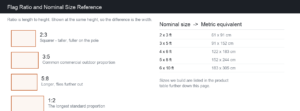
- 2:3 is the most common proportion in the world.
- 1:2 appears in flags of British descent — the United Kingdom among them.
- 3:5 and 5:8 are used by several European countries.
- 1:1 is square, used by Switzerland and Vatican City.
- Nepal is not a quadrilateral at all.
The commercial problem is straightforward: if you order every country’s flag in its own official proportion, a set of twelve flags will hang at twelve different widths. For a permanent display — a row along a reception wall, a set in a conference room, a run of flagpoles in a plaza — that usually looks wrong. Most institutional buyers therefore standardise on one size and one ratio and accept that some designs are being reproduced at a proportion the country does not officially use. Others standardise the width only and let the height vary.
Whichever route you take, decide it before the order rather than after, because the flag size you choose then determines the pole it needs. The size and ratio relationships are set out in more detail in our flag sizes and common ratios reference.
What a multi-country order has to specify
Six decisions cover almost every “flags of the world” enquiry we receive:
- The country list. Any country can be produced, and one order can mix several countries — a curated set for a protocol display, an education wall, a hotel lobby or an event, rather than a single national flag.
- The size, and whether it is uniform. The standard display size is 3 × 5 ft, and the size can be adapted to a particular national flag’s proportions — 3 × 6 ft, for example, where a design needs the extra length. Hand-held flags run about 14 × 21 cm. Because official proportions differ from country to country, this is the decision that determines whether the finished set hangs evenly. See above.
- The fabric. Satin is the top tier and is intended for indoor use only, where the flag is judged on how it drapes and how the colour reads under interior light. Oxford, polyester and nylon are each available in different fabric weights, so a buyer can trade colour depth and durability against cost and pack volume. Outdoor rows generally want oxford or polyester; hand-held flags usually want the lighter options.
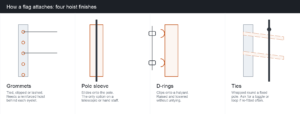
- The attachment. Pole sleeve, grommets or ties — specified per order. A sleeve produces the straightest hanging edge, grommets suit poles fitted with halyards and rings, and ties suit smaller flags. Each has a specific trade-off, covered in our flag attachment guide.
- Hand-held or full size. A large proportion of “flags of the world” demand is for small hand-held flags used at events and by schools — usually a different product from the large display flags, with its own pole and its own carton. Most popular countries are held in stock as hand-held flags, which is what makes a short-notice event order possible. We build both.
- Finishing and packing. Fringe and tassel for ceremonial use. Flags are packed in OPP bags, and the packing itself can be customised — including a plan that keeps one country’s flags together and labelled, so that nobody has to sort a hundred flags out of one carton on site.
Minimum order and lead time
The minimum order quantity on custom national flags is 500 pieces. For items held in stock — the hand-held flags and standard sizes for popular countries — dispatch runs at about 3 to 7 days. Sets that are printed to order take longer, and the artwork for each country has to be confirmed first.
A note on official designs
Some national flags carry restrictions on how the design may be used, and a few incorporate emblems subject to national regulation. We reproduce designs to the artwork and proportions a buyer supplies and do not advise on the legal or protocol conditions of display in the destination country. Buyers running official, diplomatic or ceremonial programmes should confirm those conditions themselves.
Beyond national flags: corporate and other designs
Not every order is a country. The same production line runs corporate and brand flags, state, provincial and city flags, association and club flags, and historical or ceremonial designs. There is no restriction to the national range — if a design can be supplied as artwork, it can be produced, and it is the artwork that decides the specification rather than the country list.
Where the artwork does not exist yet, we can supply a design mockup so that layout, proportions and colours are agreed before the order goes to print. For a first order of an unfamiliar design, that proof is usually the step that removes the risk.
Ordering
We manufacture custom national flags in any country list, in oxford cloth, polyester, nylon or satin, in hand-held and full display sizes, with the attachment, finishing and packing the order requires. Because the artwork is supplied per country, the practical sequence is a country list, a size decision, a material choice and a packing instruction — then the set is quoted and sampled.
Get a quotation
Send the country list, the size and the intended use — an indoor row, hand-held event flags, or a set for a conference — and we will come back with the material options, the attachment and finishing that fit, and what can come from stock.