
China Best Wall Mounted Flagpole Supplier Global Buyers
Global buyers are seeking more than a decorative pole. They need a Wall Mounted Flagpole that remains secure, attractive, and practical under changing weather conditions. China has become an important manufacturing base for aluminum poles, stainless-steel brackets, outdoor fabrics, and custom finishing. Yet supplier quality can vary widely. That matters.
Grand View Research’s Flags and Banners Market report identifies commercial branding, public institutions, hospitality, and events as major demand areas. Fortune Business Insights also reports continued growth in the global flags and banners market, supported by retail, government, and architectural applications. These reports do not measure wall-mounted systems separately. That limitation deserves attention. Still, they indicate expanding demand for durable outdoor display products.
According to flagpole installation specialist Michael J. Rizzo, “The bracket is only as reliable as the wall behind it.” This practical observation reflects a central purchasing issue. Buyers should review bracket thickness, fastener compatibility, tube diameter, finish quality, drainage, and wind exposure. A polished sample may hide weak welds or unsuitable anchors. Small details become expensive problems later.
A dependable China Wall Mounted Flagpole supplier should provide material specifications, dimensional drawings, installation guidance, packaging photographs, and consistent inspection records. ISO 9001 certification can support process control, but it does not replace product testing. Buyers should request evidence. They should also compare corrosion resistance for coastal, industrial, and high-humidity locations. The best supplier is not always the cheapest. Sometimes, the cheaper option simply moves the cost downstream.
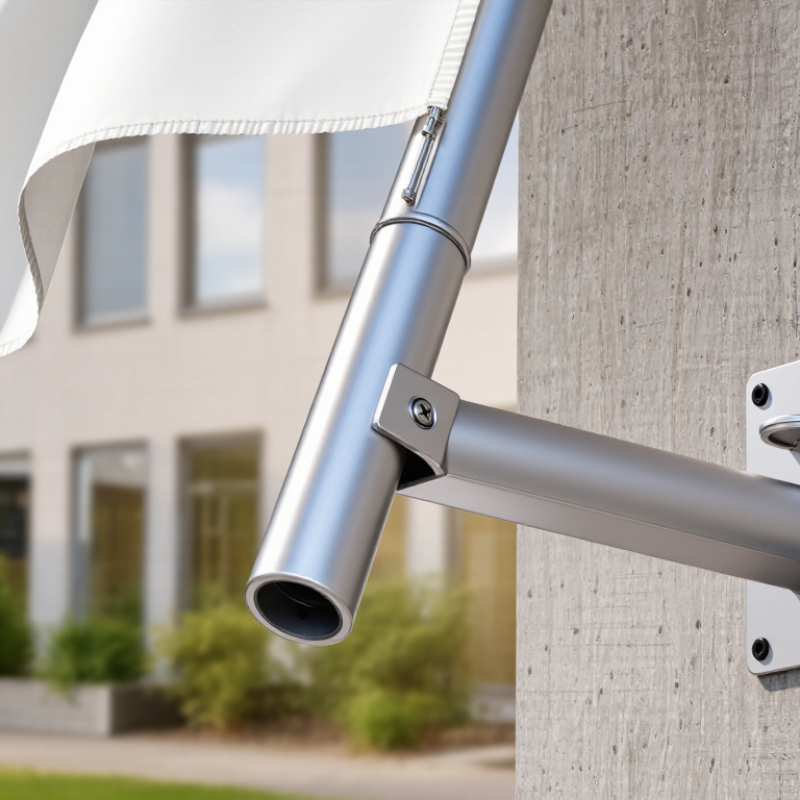
Wall-Mounted Flagpoles: Structure, Materials, and Main Features
Wall-mounted flagpoles use a wall plate, vertical tube, brackets, a halyard, and a finial. The wall plate transfers wind pressure into masonry or structural framing. Brackets must resist bending, vibration, and repeated flag movement. A small gap behind the tube helps drainage and reduces trapped moisture.
Aluminum is popular because it is lightweight and naturally corrosion-resistant. The International Aluminium Institute reports that about 75% of all aluminium ever produced remains in use. This supports long serviceability when the finish is maintained. Steel offers higher stiffness, especially for larger flags, but needs galvanizing or a protective coating. The NACE IMPACT study estimated global corrosion costs at about US$2.5 trillion annually, or 3.4% of global GDP. That figure makes surface protection more than a cosmetic choice.
Practical features matter. Hinged brackets simplify lowering in narrow streets or crowded entrances. Stainless fasteners reduce rust staining around drilled holes. Powder coating provides color control, but damaged edges still need prompt repair. Choose the mounting surface carefully. Brick veneer may look solid, yet it cannot always carry structural loads safely. Wind exposure also changes by building height, local terrain, and flag size. A supplier’s load calculation should identify these conditions, not hide them behind a generic rating. In my experience, drainage holes are often overlooked. They should not be.
China Best Wall Mounted Flagpole Supplier Global Buyers - Wall-Mounted Flagpoles: Structure, Materials, and Main Features
| Data Dimension | Typical Specification or Value | Structure / Material Detail | Main Buyer Consideration |
|---|---|---|---|
| Mounting Type | Wall, column, balcony, or facade mounted | A base plate or mounting bracket is fixed to a vertical surface with mechanical fasteners. | Check wall condition, available fixing depth, and access for installation. |
| Common Pole Length | 0.6–2.0 m | Short poles are suitable for entrances, shopfronts, balconies, and building elevations. | Select length according to facade scale, flag size, and local wind exposure. |
| Typical Pole Diameter | 20–38 mm for light and medium-duty models | Round aluminum or stainless-steel tubing is commonly used for the shaft. | A larger diameter generally provides greater stiffness, subject to wall-load limits. |
| Pole Materials | Aluminum alloy, stainless steel, or galvanized steel | Aluminum offers low weight; stainless steel offers corrosion resistance; galvanized steel offers high strength with a protective zinc coating. | Match the material to coastal salt exposure, humidity, cleaning requirements, and budget. |
| Common Stainless-Steel Grades | AISI 304 or AISI 316 | AISI 304 is widely used for general outdoor applications; AISI 316 contains molybdenum and is more suitable for marine or chloride-rich environments. | Use marine-grade stainless steel where salt spray or coastal humidity is a major concern. |
| Bracket Configuration | Fixed-angle or adjustable-angle bracket | Typical mounting angles include approximately 30°, 45°, and 90°, depending on the bracket design. | Adjustable brackets help align flags on uneven facades and accommodate different display positions. |
| Base Plate | Approx. 70 × 70 mm to 150 × 150 mm | The plate may be stamped, machined, or welded and normally includes two or more fixing holes. | Confirm plate size and hole spacing against the structural surface and selected anchors. |
| Fasteners | Stainless-steel or hot-dip-galvanized bolts, screws, and washers | Fastener type should suit masonry, concrete, steel, timber, or other substrate conditions. | Anchor selection is a site-engineering issue; the fixing system must be rated for the expected loads. |
| Surface Finishes | Mill finish, anodized aluminum, brushed stainless steel, polished stainless steel, or powder coating | Anodizing and powder coating add decorative options and can improve surface protection when properly specified. | Specify color, gloss level, coating thickness, and outdoor exposure requirements. |
| Flag Attachment | Snap hooks, clips, rings, rope, sleeve, or toggle attachments | Attachment hardware connects the flag header or reinforced corners to the pole. | Choose corrosion-resistant hardware and reinforced flag attachment points for frequent use. |
| Compatible Flag Size | Commonly 0.6 × 0.9 m to 1.2 × 1.8 m | The appropriate flag area depends on pole diameter, bracket strength, fixing method, and wind exposure. | Do not select the flag size independently from the pole and mounting hardware. |
| Wind Behavior | Flag area and wind permeability strongly affect loads | Solid fabric flags create more drag than mesh or partially perforated flags; gusts can produce higher temporary loads. | Use local wind-load requirements and consider removing flags during severe weather when appropriate. |
| Corrosion Resistance | High for stainless steel and correctly treated aluminum | Galvanized and coated steel rely on continuous protective coverage; scratches or cut edges may require maintenance. | Consider galvanic corrosion when dissimilar metals contact each other in wet or salty environments. |
| Installation Surfaces | Concrete, brick, stone, steel, timber, and reinforced facade systems | Each substrate requires compatible anchors and adequate edge distance to reduce cracking or pull-out risk. | Verify substrate strength before installation; façade cladding alone may not provide sufficient support. |
| Maintenance Requirement | Periodic inspection and cleaning | Inspect brackets, fasteners, pole joints, attachment points, and fabric wear; rinse salt and dirt from exposed metal. | A planned inspection schedule helps identify loosened fasteners, corrosion, and torn fabric early. |
| Typical Applications | Commercial buildings, hotels, public facilities, residential balconies, event venues, and retail entrances | Compact wall-mounted systems provide visible flag display without requiring ground space or a foundation. | Confirm local planning, building, safety, and flag-display requirements before procurement. |
Related Posts
-

What is a Flagpole and How to Choose the Right One?
-
What is a Wall Mounted Flagpole? Benefits, Installation, and Tips Explained
-
What is an Advertising Tent and How Does it Work?
-

How to Choose the Best Beach Flag Pole for Your Needs?
-
7 Reasons Why the Best Heavy Duty Flag Pole is a Must Have for Every Business
-

Ultimate Guide to Flag Post Best Practices and Tips?